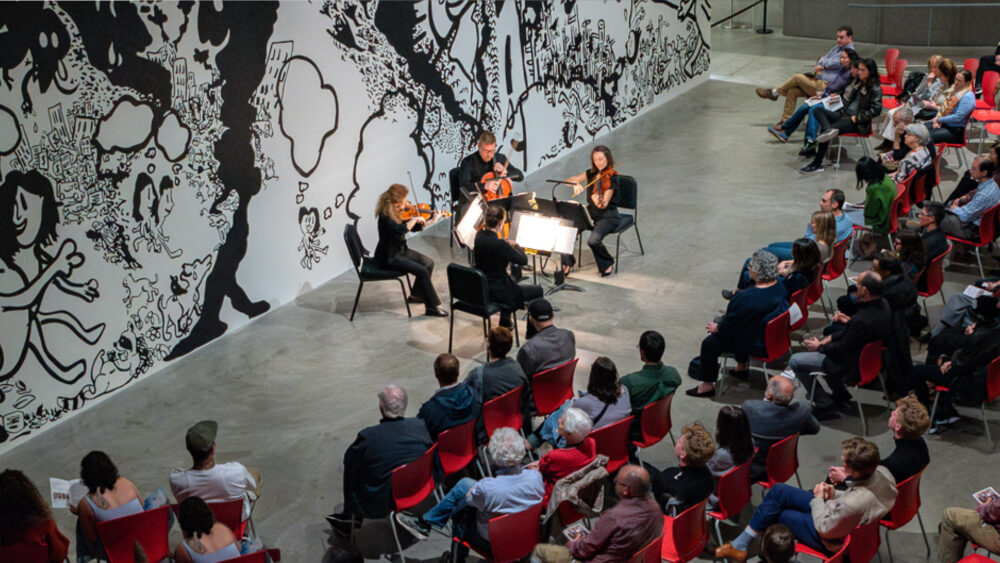
Musicians from the St. Louis Symphony Orchestra present a powerful program at CAM exploring the convergence of music and contemporary art. This musical selection takes inspiration from CAM’s spring/summer exhibitions, And I Saw New Heavens and a New Earth: The Partnership, Art, and Activism of Claude Cahun and Marcel Moore and Andrea Carlson: Endless Sunshine, to explore themes of memory and erasure in our relationships to place, land, and home. How does music allow us to honor our connections to the people and places of our past, as well as the fullness of joy and pain they hold?
Tickets are $20 for general admission or $10 for students and artists. Please click here to purchase tickets.
Program
Xiaoxiao Qiang, violin
Siyu Zhang, violin
Alejandro Valdepeñas, viola
Yin Xiong, cello
Melody McKiver, Let the Stain Remain
Kevin Puts, Home
Kaija Saariaho, Terra Memoria
George Walker, Lyric for Strings (Lament)
Schedule
- 6:30pm: Doors open to explore the galleries
- 6:30–7:30pm: Bar opens
- 7:30 pm: Performance begins
Please note: Online ticket sales close three hours before the performance. However, you can still purchase tickets in person or by calling the box office at 314-534-1700.
Performance notes
- Musician and composer Melody McKiver, a member of Obishikokaang Lac Seul First Nation, is known for integrating electronics with Western classical music to shape a new genre of Anishinaabe compositions. Her work Let the Stain Remain was commissioned as the test piece for Canada’s prestigious Eckhardt-Gramatté National Music Competition (known as the E-Gré) in 2024.
- Kevin Puts, who serves as the SLSO’s Composer in Residence this season, gives witness to the European refugee crisis through his string quartet, Home. On the work’s composition, Puts writes: “The work begins in what is essentially C Major, or with a tonal center of ‘C,’ which I intended as a sonic representation of ‘home’ and one which is abandoned after the idyllic atmosphere of the work’s first several minutes in search of new and unfamiliar harmonic terrain.”
- Terra Memoria, written in 2007, is Kaija Saariaho’s meditation on remembrance. Saariaho’s luminous harmonic language and evolving textures create a sound world that is both intimate and timeless, offering what she describes as a “tribute to those departed” while also reflecting on the traces they leave within us.
- Lyric for Strings began as the slow movement from George Walker’s first string quartet entitled “Lament,” but as a standalone work for full strings, it has become an orchestral standard. Written while he was a graduate student at the Curtis Institute of Music, Walker had just started to compose this piece when he learned that his grandmother, a formerly enslaved person, had passed away. The resulting work was created in memory of her.